The Uchida put
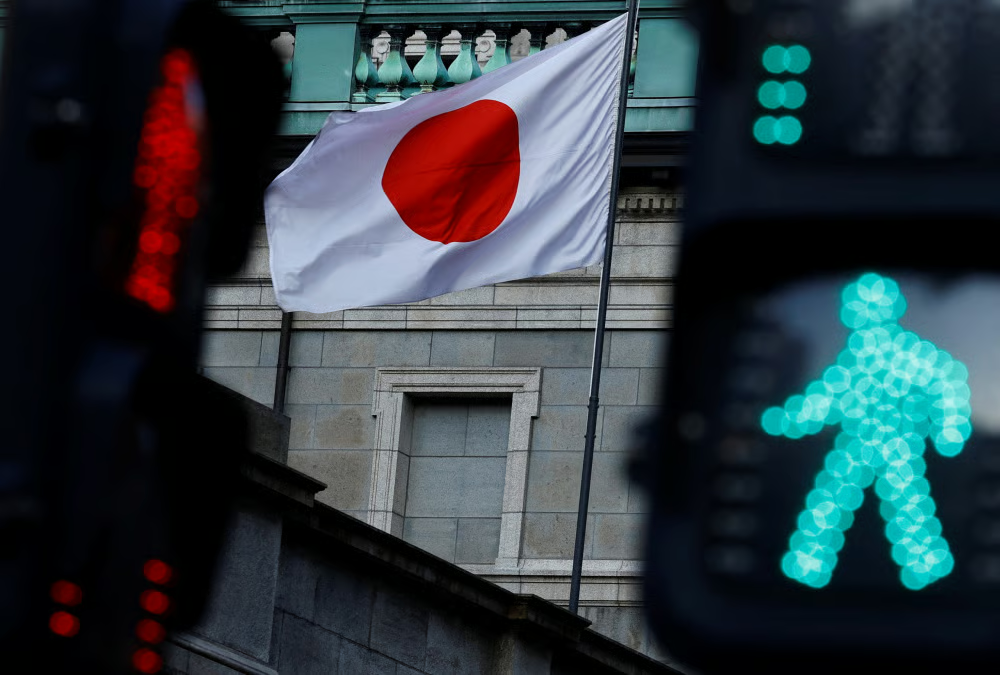
By promising in August 2024 not to raise rates during turbulent markets, the Bank of Japan offered speculators free insurance, which they have been exercising relentlessly ever since. The weak yen has its reasons—rate differentials, an oil shock, fiscal doubts—but none explain the sheer scale of the positions. Ten days away from a decisive meeting, Tokyo is finding out that the most costly liability is a promise.
On August 7, 2024, two days after the Nikkei’s most violent crash since 1987, Bank of Japan Deputy Governor Shinichi Uchida uttered a phrase that would prove very costly: the BoJ would not raise rates “when financial and capital markets are unstable.” That day, without phrasing it as such, he sold a protection option to speculators worldwide. Without a premium. Without an expiration date. Two years later, they are still exercising it.
Appearances, however, have been saved. The Bank of Japan has pursued its normalization: 0.25% in July 2024, 0.5% in January 2025, 0.75% in December, and on June 16th last, 1%—unseen since 1995. That day, Governor Kazuo Ueda being absent for health reasons, it was Uchida—him again—who spoke. His tone was hawkish this time: risks to prices, a refusal to “fall behind the curve.” The market listened politely. By late June, the yen dropped to 162.5 against the dollar, very close to its 40-year low.
Let’s be honest: the weak yen has causes that owe nothing to Uchida. First, the interest rate differential—1% in Japan versus over 4% on short-term US Treasury yields: as long as it persists, borrowing in yen to invest in dollars remains an arithmetic no-brainer. Second, the energy bill: the US-Iranian war is sending crude oil soaring, and the archipelago, which imports its oil from the Gulf, sees its terms of trade deteriorate with every barrel. Finally, fiscal doubts: if the 10-year JGB peaks between 2.7% and 2.85%, at 30-year highs, it is as much out of fear of Japanese fiscal drift as it is due to monetary anticipation. Three headwinds, all real. They explain the direction of the yen. Not the magnitude of the positions nor, above all, the perceived asymmetry of risk.
Because the Uchida put does not create the trend: it distorts the risk. An unfavorable wind justifies a short position, not the extremes reached. As of June 30, leveraged funds held nearly 138,000 net short contracts on the yen, their most extreme position since 2007 according to CFTC data, under carry trade conditions deemed by Goldman Sachs to be the most favorable since 2000. What the August 2024 promise eliminated was fear—that brutal appreciation which periodically ruined short sellers and capped positions. Speculators are not betting against the BoJ; they are betting, insured, on its prudence. The bet would exist without Uchida. It simply wouldn’t be the same size.
And while the central bank hesitates, the Treasury bails out. In April-May, the Ministry of Finance sold more than 73 billion dollars in foreign exchange reserves to support the yen. This operation, let’s be clear, does not constitute a budgetary expense: Tokyo is parting above 155 with dollars accumulated at much lower exchange rates and can even record a capital gain. But it only addresses the symptom, and every intervention exposes the institutional contradiction: the left hand buys back what the right hand’s words continue to sell.
Inflation itself forbids any simple escape. The core consumer price index remained at 1.4% in May, its fourth consecutive month below target—June, published on July 24, is expected at 1.6%—but the forecast for fiscal year 2026 has been revised upward to around 2.8% due to the oil shock. Sluggish domestic inflation, threatening imported inflation: the BoJ is summoned to choose between two errors. The board itself is divided—the June hike was voted 7 to 1, with Toichiro Asada arguing that risks to production and employment outweighed the inflationary risk. And the government is further blurring the message: after an initial version of its economic doctrine raised fears of interference, the final text had to reaffirm that the choice of instruments belonged to the BoJ—while the executive pushes the GPIF toward domestic assets.
Two scenarios, therefore. Either the BoJ, faced with the next squall, plays for time: it validates the 2024 precedent, the free insurance is renewed, and positions grow even larger. Or it tightens harder than expected: unwinding kicks off on much more massive outstanding amounts than in August 2024; the yen appreciates sharply, Japanese stocks drop, and then the shock spreads to risky assets worldwide. This is the inherent mechanism of moral hazard: each validation of the first scenario increases the violence of the second.
A tremor, already: in the broader series of non-commercial traders, net short positions, after peaking at 155,000 contracts, fell back to around 123,000 under the effect of intervention threats. This is a sign that the edifice rests less on fundamental conviction regarding the yen than on the implicit protection attributed to the BoJ. The first test is coming fast: it meets on July 30 and 31, and consensus expects a status quo. It will be necessary to watch the tone rather than the decision. With the US and oil environment unchanged, a dollar-yen sustainably below 150 would mean that markets are starting to fear the central bank again. A slide beyond 165 would mean that the market continues to price the Uchida put as free insurance.
For decades, Japan lent to the world under conditions of unprecedented generosity. Today, as it tries to return to a country with normal interest rates, it discovers that the hardest part is not raising rates. It is buying back a promise. The one from August 2024 was never listed anywhere. Yet, to this day, it is the heaviest liability on the Bank of Japan’s balance sheet.
Dear readers,
This blog is yours: I maintain it diligently, with both consistency and passion. Thousands of articles and analyses are available to you here, some dating all the way back to 1993!
What were once considered heterodox views on macroeconomics have, over time, become widely accepted and recognized. Regardless, my positions have always been sincere.
As you can imagine — whether you’re discovering this site for the first time or have been reading me for years — the energy and time I dedicate to my research are substantial. This work will remain volunteer-based, and freely accessible to all.
I’ve made this payment platform available, and I encourage you to support my efforts through one-time or recurring donations.
A heartfelt thank you to all those who choose to support my work.